Independent Program Authority
Your AI Is Already Running. Is Anyone Watching It?
Without independent governance, capital exposure multiplies across vendor seams—turning promising technology into permanent prototypes. That’s not a future risk. It’s a current one.
If the project is the investment, we are the insurance.

Frederick Lietzman
Founder · Program Authority
New from Agentic Insight
Introducing HELOCOM™
You are experiencing it right now. HELOCOM is the voice‑first interface that greeted you when you arrived. It activates automatically the moment a visitor lands on your website — before they scroll, before they read a single word — and introduces your organization by voice.
It has a focused conversation about what your organization does and how it can help. When your visitor is ready to take the next step, HELOCOM delivers them there automatically. No navigation. No searching. No button to push.
HELOCOM is not a chatbot. It is not a popup. It is purpose‑built for one organization — yours — and it speaks for no one else.
Would you like to add HELOCOM to your website? Visit helocom.ai →Three Ways Agentic Insight Helps
Agentic Insight helps serious owners adopt AI at the right level — from practical business modernization to high-stakes Program Authority. The goal is the same at every size: find where AI creates value, where technology can break, and what to do before money is wasted.
For Local & Small Business
Practical AI Modernization
For small businesses, local operators, and owner-led companies that need AI to solve real operational problems now.
Many companies do not need a massive AI program. They need better customer intake, fewer missed calls, faster follow-up, smarter scheduling, an AI-enabled website, or automation across the tools they already use.
Common Needs
- AI receptionist and website assistant
- Customer intake and missed-call recovery
- Dispatch and scheduling workflow improvement
- CRM, billing, and follow-up automation
- AI-enabled website modernization
- Vendor and software selection guidance
For Growing Companies
AI Operations Integration
For growing companies with multiple systems, vendors, staff workflows, and operational friction.
Once AI touches dispatch, CRM, billing, inventory, scheduling, customer communication, or multiple locations, the problem becomes operational integration. Agentic Insight maps the systems, identifies the highest-value automation path, and helps owners avoid buying the wrong platform.
Common Needs
- Workflow and systems mapping
- CRM, billing, dispatch, and reporting alignment
- AI operations roadmap
- Vendor selection and implementation sequencing
- Owner dashboard and automation strategy
For High-Capital Programs
Program Authority
For larger organizations, serious capital projects, robotics, automation, AI vendors, investors, and boards.
High-stakes AI programs fail when ownership, vendors, platforms, requirements, and operational intent collide. Agentic Insight acts as the independent authority protecting the owner’s interest before the project becomes a permanent prototype.
Common Needs
- Definition of Done
- Vendor accountability framework
- Platform dependency review
- Behavioral control and governance
- Operational readiness gates
- Executive risk reporting
AI Opportunity & Exposure Assessment
Observer
Observer identifies which path fits your company: practical AI modernization, AI operations integration, or Program Authority. Before you spend serious money, know exactly where AI can create value and where it can fail.
Who Observer is for
Mid-market manufacturers and logistics companies — $50M to $500M in revenue — that have deployed or announced AI automation initiatives without a formal behavioral control framework.
What a behavioral control gap is
Any point in your AI system where there is no defined, enforced constraint on how the system acts. Monitoring tells you if it’s running. Behavioral control tells you if it’s acting within sanctioned boundaries.
Regulatory pressure is building
AI oversight frameworks are advancing in the US and EU. Insurance underwriters are beginning to ask governance questions. Observer gives you a documented answer before someone requires one.
Seven days. One deliverable. No surprises.
You receive the AI Behavioral Control Risk Report — a complete inventory of active AI systems, identified behavioral control gaps, a governance exposure map, and remediation priorities. No retainer obligation.
AI Integrations Fail at the Seams
The greatest risks in modern AI programs are not algorithm performance. They are structural failures between vendors, contracts, platforms, and operational intent. Without independent governance, complex AI integrations predictably fall into three failure modes.
Capital Exposure
Undefined outcomes allow budgets to burn without measurable progress toward operational readiness. Multiple vendors deliver components, but no authority governs whether those components actually produce the intended system.
IP Fragmentation
When multiple vendors contribute to a system, intellectual property fragments across hardware, firmware, models, software layers, and contracts. Clients often discover too late that the behavior of their own system depends on technology they do not control.
Permanent Prototype
Many AI programs demonstrate impressive prototypes but never reach stable production. The missing ingredient is usually the same: no written Definition of Done governing the complete system.
If the project is the investment, the ungoverned seams are where the value leaks out.
The Cognitive Stack
Every AI system operating in the physical world depends on three interacting layers. Most teams understand one or two. Failures occur at the seams between them.
Control Model — Physical Capability
Robotics hardware, actuators, motion control, and mechanical execution.
Typically owned by the hardware manufacturer.
World Model — Environmental Understanding
Vision systems, spatial reasoning, language models, and environmental interpretation.
Often controlled by platform vendors.
Task Model — Operational Identity
Workflows, behavioral standards, service protocols, escalation logic, and the definition of what the system is meant to do. The Task Model must remain client-owned intellectual property.
Agentic Insight Authority. This is where your IP and enterprise value live.
Agentic Insight governs the seams between CM, WM, and TM.
Preserving behavioral stability, ownership clarity, and operational intent.
Three Levels of Program Authority
Organizations engage Agentic Insight at three stages depending on the maturity of their AI program.
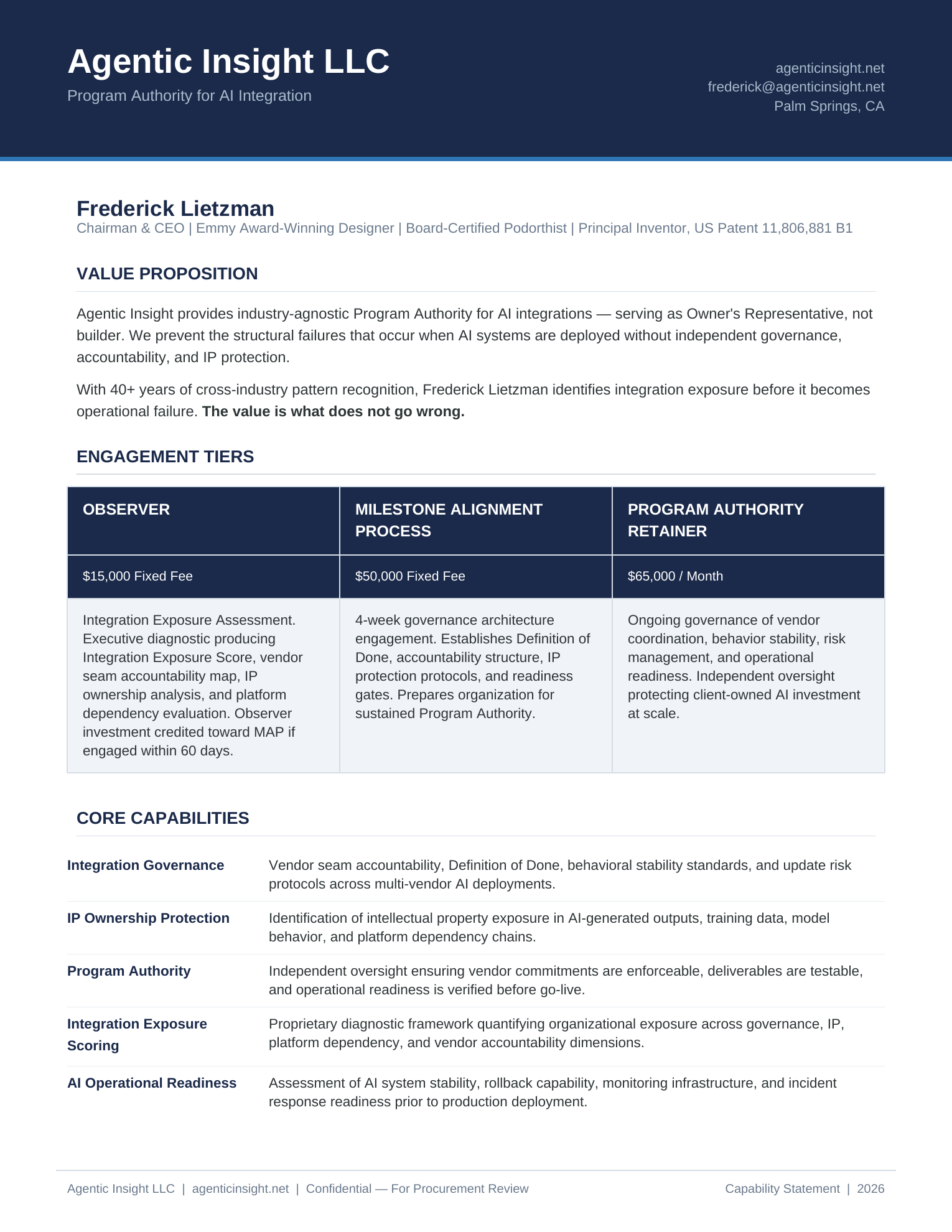
Tier 1
Observer — AI Behavioral Control Readiness Assessment
$15,000
Executive Diagnostic
Identify structural risks before capital exposure escalates.
Client Receives
- Integration Exposure Score
- Vendor seam accountability map
- IP ownership exposure analysis
- Platform dependency evaluation
- Integration readiness assessment
- Executive recommendations
Tier 1 investment credited toward MAP if engagement proceeds within 60 days.
Tier 2
Milestone Alignment Process
$50,000
4-Week Governance Architecture
Convert a concept or unstable prototype into a governable program.
Client Receives
- Written Definition of Done
- Vendor accountability framework
- Integration architecture validation
- IP protection review
- Operational readiness gates
- Go / No-Go recommendation
Tier 3
Program Authority Retainer
$65,000/month
Ongoing Integration Governance
Keep the program aligned as vendors evolve and complexity increases.
Responsibilities
- Vendor coordination and accountability
- Change control and risk management
- Readiness gates and milestone validation
- System behavior governance
- Operational stability oversight
- Weekly executive signal brief
Procurement-ready: SOW templates and insurance certificates available upon request.
Integration Exposure Score
Most organizations cannot easily measure structural risk in AI integrations. The Integration Exposure Score evaluates five core governance conditions that determine whether a system is stable, ownable, and deployable.
1. Definition of Done
Do all vendors operate under a written, testable Definition of Done governing the complete system?
2. Task Model Ownership
Does the client contractually own the Task Model governing system behavior?
3. Vendor Seam Accountability
Is responsibility clearly defined for failures occurring between vendors?
4. Platform Dependency Control
Can external platform or model updates alter system behavior without client approval?
5. Operational Readiness Gates
Are formal readiness gates defined before deployment?
A low score does not mean the technology cannot work. It means the system is being built without adequate governance, ownership protection, or operational control.
Example Integration Exposure Report
Tier 1 produces a concrete executive diagnostic, not a vague consultation.
Sample Findings
• No enforceable Definition of Done across vendors
• Task Model ownership retained by vendor
• No written accountability for seam failures
• Platform updates capable of altering system behavior without approval
• No formal readiness gates before deployment
Sample Recommendation
Proceed to MAP to establish governance architecture, define the operational outcome, and protect client ownership before additional capital is committed.
The Integration Arc — Four Decades of Pattern Recognition
1988 — Integration Origin
Pioneered unified fuel pump, retail POS, and car wash integration—one of the earliest multi-vendor convergence models in retail infrastructure.
1989 — IBM Partnership
Recognized that competing with the dominant personal computing platform of the era was a losing strategy and instead established an installation partnership with IBM. IBM closed enterprise hardware sales while the firm I represented deployed and supported systems for police, fire, and education networks across Kern County, California.
Applied AI Patent
Inventor—US Patent 11,806,881 B1: Artificial intelligence system for automatic tracking and behavior control of animatronic characters. A real-world foundation for bridging AI decision-making to physical action in any domain where autonomous systems interact with the human environment.
Across four decades of technology transitions, the common thread has been recognizing integration risks before they become operational failures.
Frederick Lietzman
Founder · Program Authority · Palm Springs, California
Frederick Lietzman founded Agentic Insight on a simple premise: forty years of watching integration projects fail creates a library of pattern recognition that no checklist can replicate. He is the named inventor on US Patent 11,806,881 B1 for AI behavioral control of autonomous physical systems. He leads Agentic Insight’s Program Authority practice as principal operator.
LinkedIn →Have a question right now? Ask HELOCOM — the voice‑first AI on this site can answer questions about Agentic Insight, Observer, the Integration Exposure Score, and whether a 20‑minute call is the right next step.
If the Project Is the Investment, We Are the Insurance
Major AI and robotics programs represent eight-figure capital exposure. Your vendors may be exceptional. But without independent governance, no single party protects the outcome.
Agentic Insight ensures the system becomes the operational asset you intended to build.